
+- Hack Forums (https://hackforums.net)
+-- Forum: Tech (https://hackforums.net/forumdisplay.php?fid=444)
+--- Forum: Webmasters (https://hackforums.net/forumdisplay.php?fid=141)
+---- Forum: SEO and Internet Marketing (https://hackforums.net/forumdisplay.php?fid=142)
+---- Thread: [Legends] From Search to Generation: The Shift from SEO to GEO (/showthread.php?tid=6304649)
From Search to Generation: The Shift from SEO to GEO - JoseMar - Aug 1, 2025
From Search to Generation:
The Shift from SEO to GEO
The Shift from SEO to GEO
Why GEO Matters Now
Here’s the thing: how people find stuff online is changing. Not slowly. Not subtly. It’s shifting in a way that’s kind of uncomfortable to watch if your job, like mine, used to revolve around keywords and clicks.
Before, we “searched.” We typed stuff into Google and scanned through links like we were skimming a buffet. Now? People are prompting. They’re asking questions directly to AI. Sometimes in full sentences, sometimes not. And increasingly… they're not clicking anything at all.
They just read the answer the AI gives back. And move on.
That’s where GEO, Generative Engine Optimization, comes in. It’s not a buzzword. It's an adjustment. A survival tactic, maybe. You can’t optimize for clicks if there are no clicks. And honestly? We’re already seeing that play out:
- AI summaries are becoming the first and only thing people read.
- Organic traffic is dropping (in some industries, it's falling fast).
- Publishers are bracing for 20–40% traffic losses. That’s not a rounding error.
But, important, this doesn’t mean SEO is obsolete. It means it’s no longer the only strategy that matters. The goal isn’t just to be found in search anymore. It’s to be part of the answer.

SEO vs GEO: What's the Difference?
Alright, quick reality check.
SEO and GEO aren’t enemies. One didn’t replace the other. It’s more like... SEO is your passport, and GEO is how you get invited into the room.
Here’s how they break down:
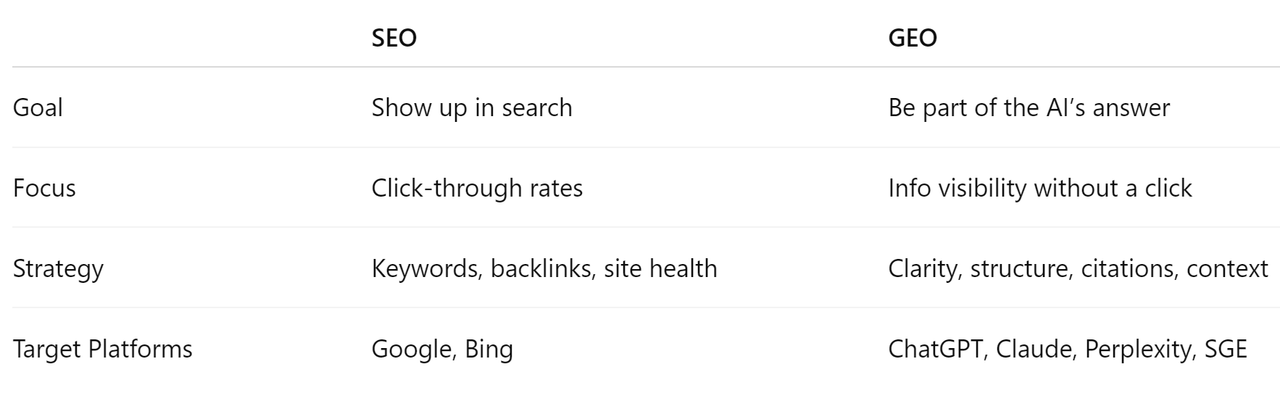
GEO isn’t about getting someone to visit your site. It’s about getting your voice, your expertise, your name, into the answer someone reads from a machine.
That’s a big shift. Not bad. But big.
The Anatomy of GEO
So what does GEO actually involve? Three parts, really. Same skeleton as SEO, just… re-prioritized.
- Technical Stuff (sorry, it matters)
- Schema markup
- Semantic structure
- Clean URLs
- Crawlable pages
You want the AI to understand what your content means, not just that it exists. If the structure is a mess, the models skip you.
- Schema markup
- On-Page Content
It’s less about cramming keywords and more about being understandable. Helpful. Scannable. And honestly, trustworthy.- Clear headings
- Natural language
- Sources, citations, credibility
If you write like a real person, answer real questions, and back it up? You’re in good shape.
- Clear headings
- Off-Site Signals
This part’s a little fuzzier, but still huge. It’s about being mentioned in the places that matter, places AI models respect.
Wikipedia. Reddit. High-authority sites. Think of it like digital street cred.
Preparing for a Zero-Click World
This phrase, “zero-click”, gets tossed around a lot. But what it really means is: answers without visiting you.
Your audience still gets value. They just don’t land on your site to get it.
So the question becomes: how do you still show up?
Here’s how:
- Make Your Content Parseable by AI
That means no PDFs behind forms. No heavy JavaScript pages that choke crawlers. Keep it structured. Use schema. And speak in full thoughts, AI loves that.
- Use More Than Just Text
If your site is just blog posts, you’re leaving power on the table. AI tools are surfacing charts, videos, interactive widgets. You don’t need to become a YouTuber, just broaden the format mix.
- Change How You Measure Success
Clicks and conversions? Still important. But now we also care about citations. Are you showing up in the answer? Is your content being used, even paraphrased, by AI models?
If it is, that's a win. Even if your traffic dashboard doesn’t spike.
- Write Like You’re Answering a Real Person
Because you are. AI doesn’t like vague. Or fluffy. Or “thought leadership” that says nothing. Just answer the question. Use examples. Be real.
FAQ about Generative Engine Optimization (GEO)
Can technical issues mess up my GEO strategy?
Yes, and probably in ways you won’t catch unless you’re looking for them. If your schema is broken or your page load times out a crawler, you’re invisible. AI models don’t wait around.
How’s GEO trust-building different from SEO?
SEO builds trust through links and authority. GEO builds it through clarity and structure. AI needs to understand what you’re saying before it can trust or cite you.
Is Reddit actually more important now?
Kinda, yeah. AI likes sources that feel human and experience-driven. Reddit, Quora, Wikipedia, they’re loaded with context. If you’re answering questions helpfully there? That shows up in GEO.
Should I still use keyword tools?
Yes, but differently. Don’t just look for “high volume.” Look for the way people ask questions. GEO is more about intent than numbers.
How do I know if GEO is working?
Honestly? It’s still tricky. Tools like ScrunchAI are starting to help, but most of us are still tracking the old-fashioned way, by testing prompts, watching citations, and looking at where we show up.
This isn’t about chasing every new acronym.
It’s about staying visible in a world where the rules are shifting. If you’re still playing for clicks and rankings only, you’re missing the bigger opportunity, to become the source behind the AI’s voice.
SEO isn’t dead. But it’s not the only thing anymore.
GEO asks a new question:
When someone prompts an AI… are you in the answer?
That’s what we’re optimizing for now.